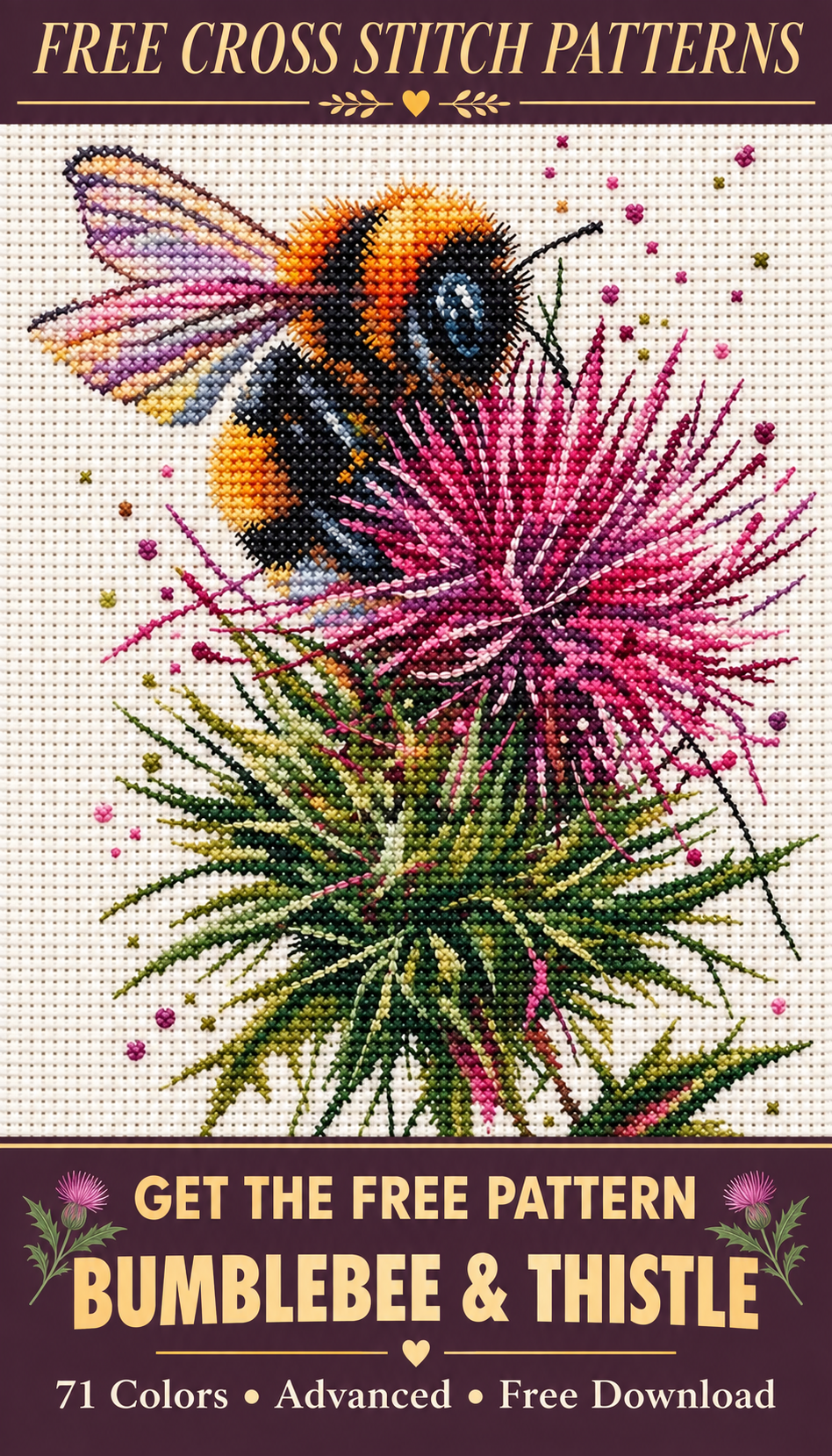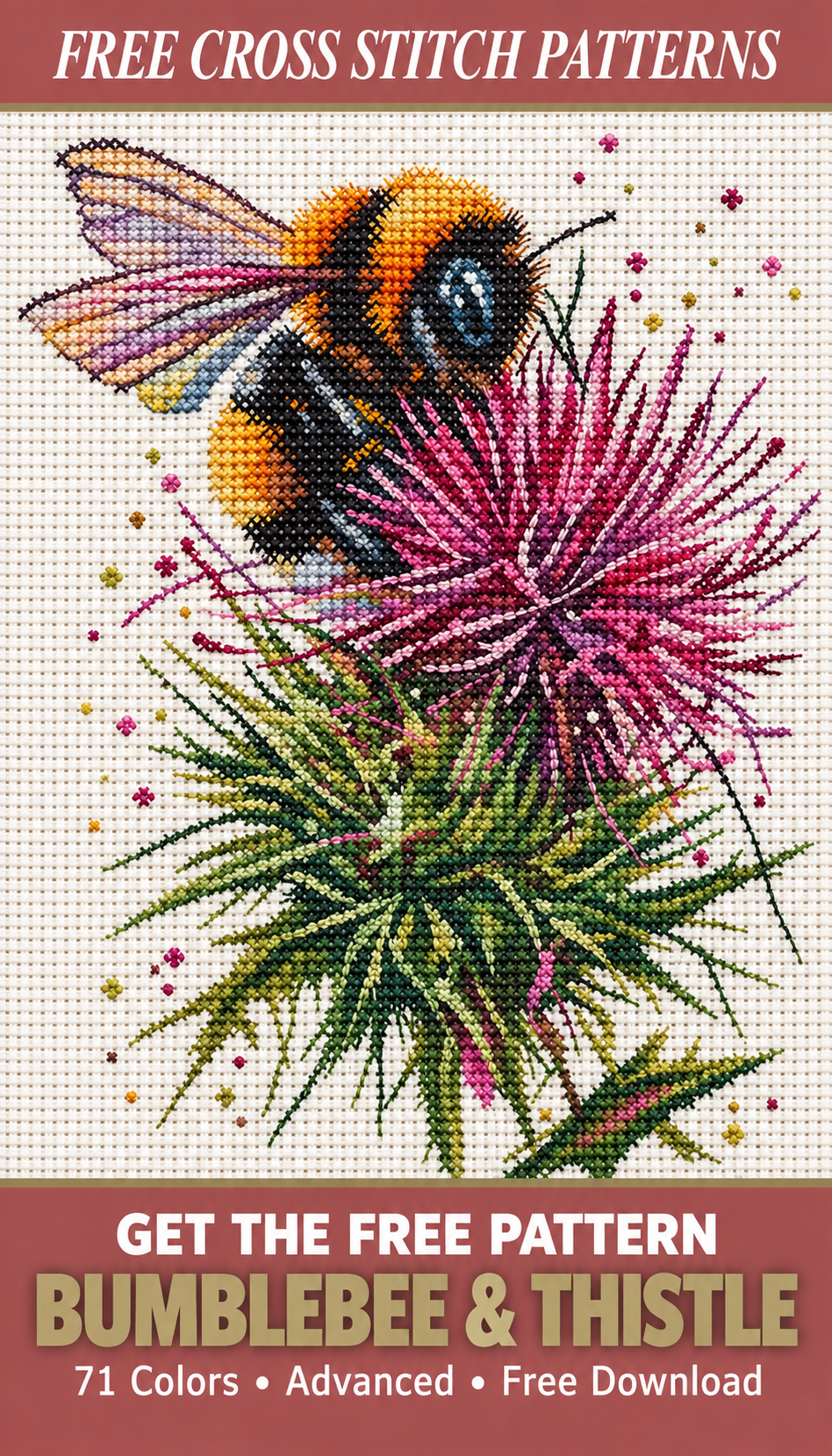
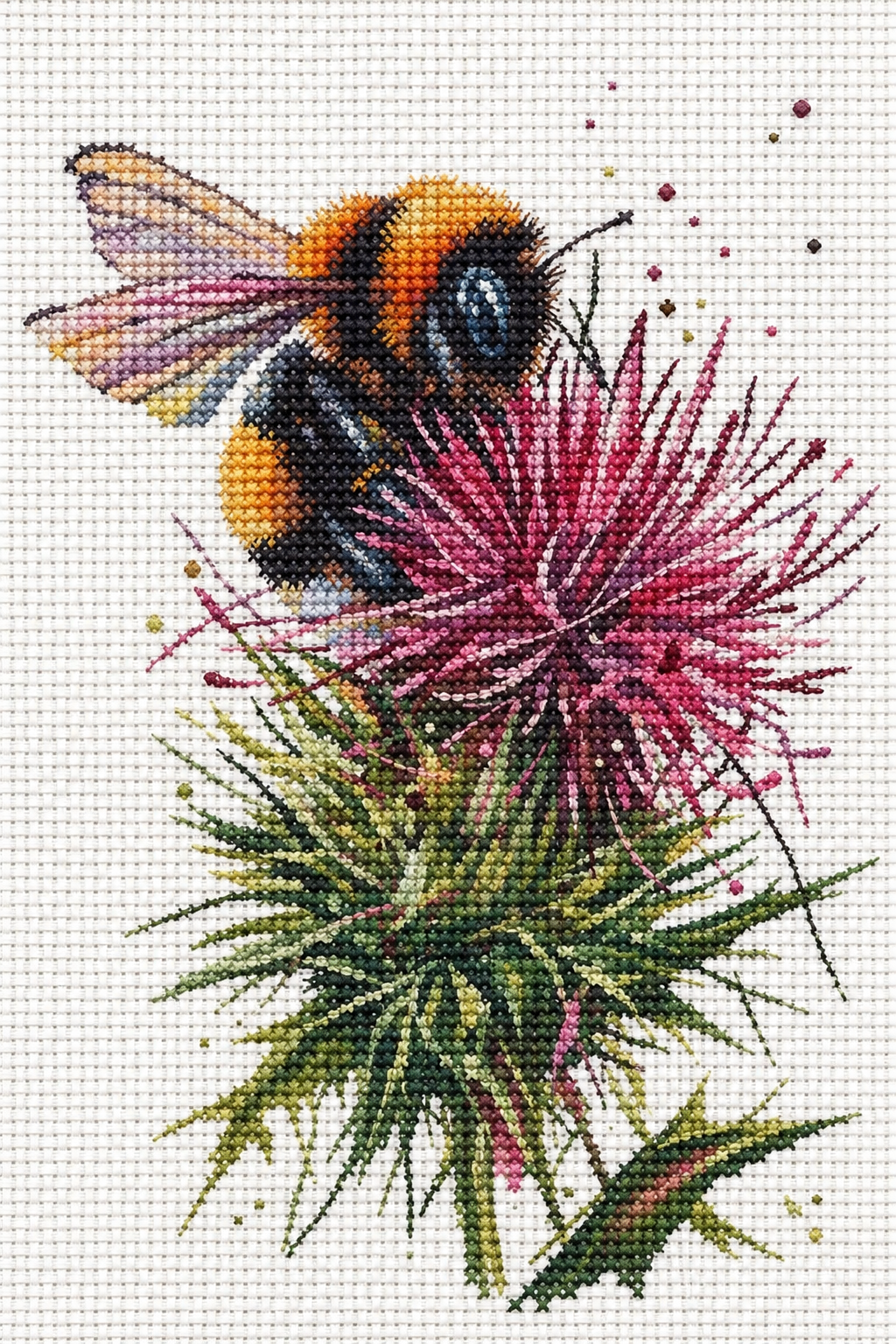
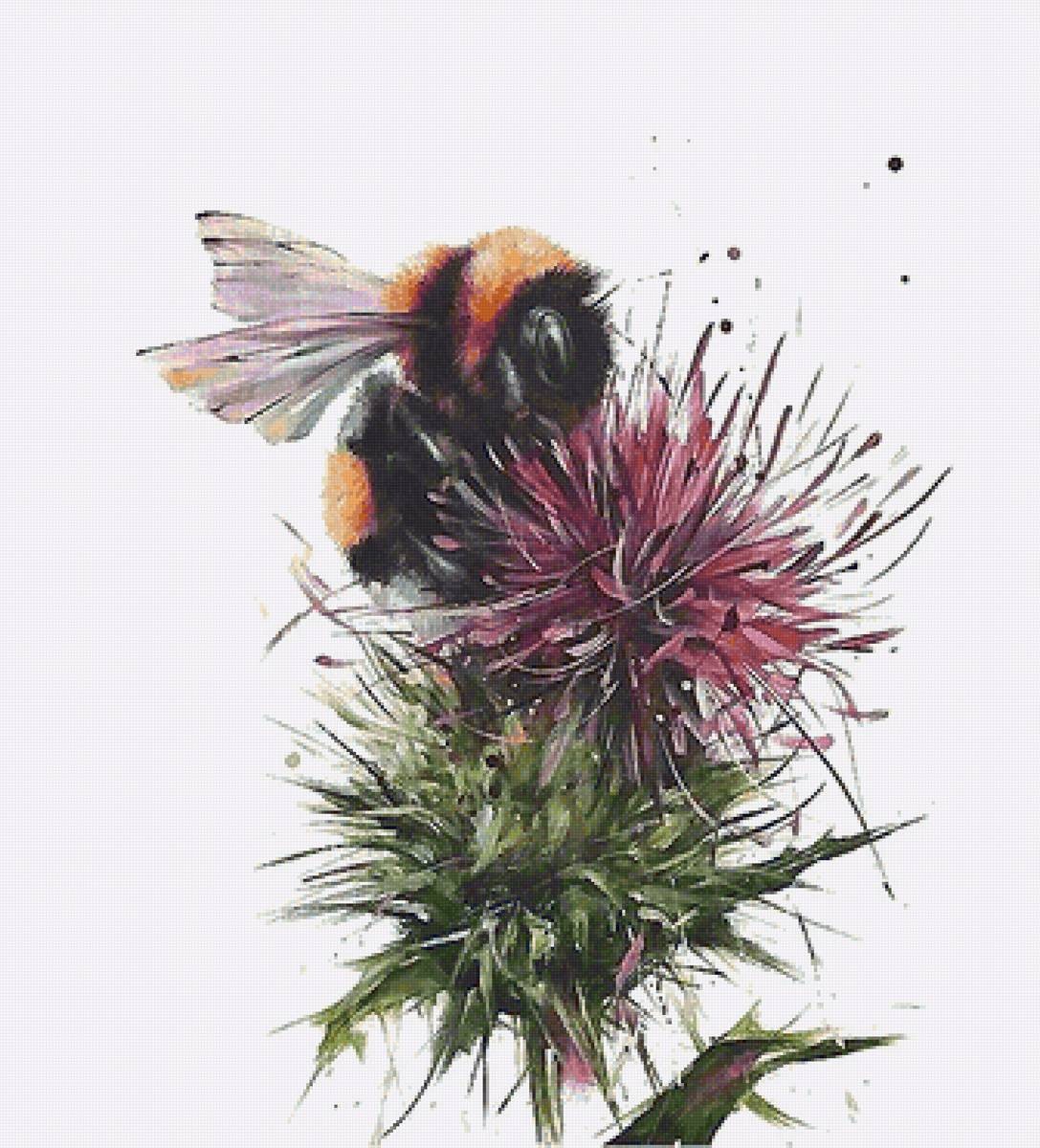
There’s something irresistible about a fat, fuzzy bumblebee caught mid-forage — and this design captures exactly that moment, wings still blurred with motion as it settles onto a spray of purple thistle. Loose, painterly splatter details around the bee give the whole piece the feel of a watercolor sketch rather than a stiff, traditional cross stitch chart.
This is a big, richly-blended full coverage design, so it’s best suited to stitchers who already have a few projects under their belt and don’t mind a slow, meditative stitch. Both a full-color chart and a black & white symbol-only chart are included free below, along with everything you need to know before you start.
In this article

Pattern At a Glance
- Difficulty: Advanced (Large Project)
- Fabric: 14-count Aida recommended (works on 14–28 count)
- Stitch Count: 336 × 371 stitches
- Finished Size: approx. 24.0 × 26.5 in / 60.9 × 67.5 cm on 14-count Aida
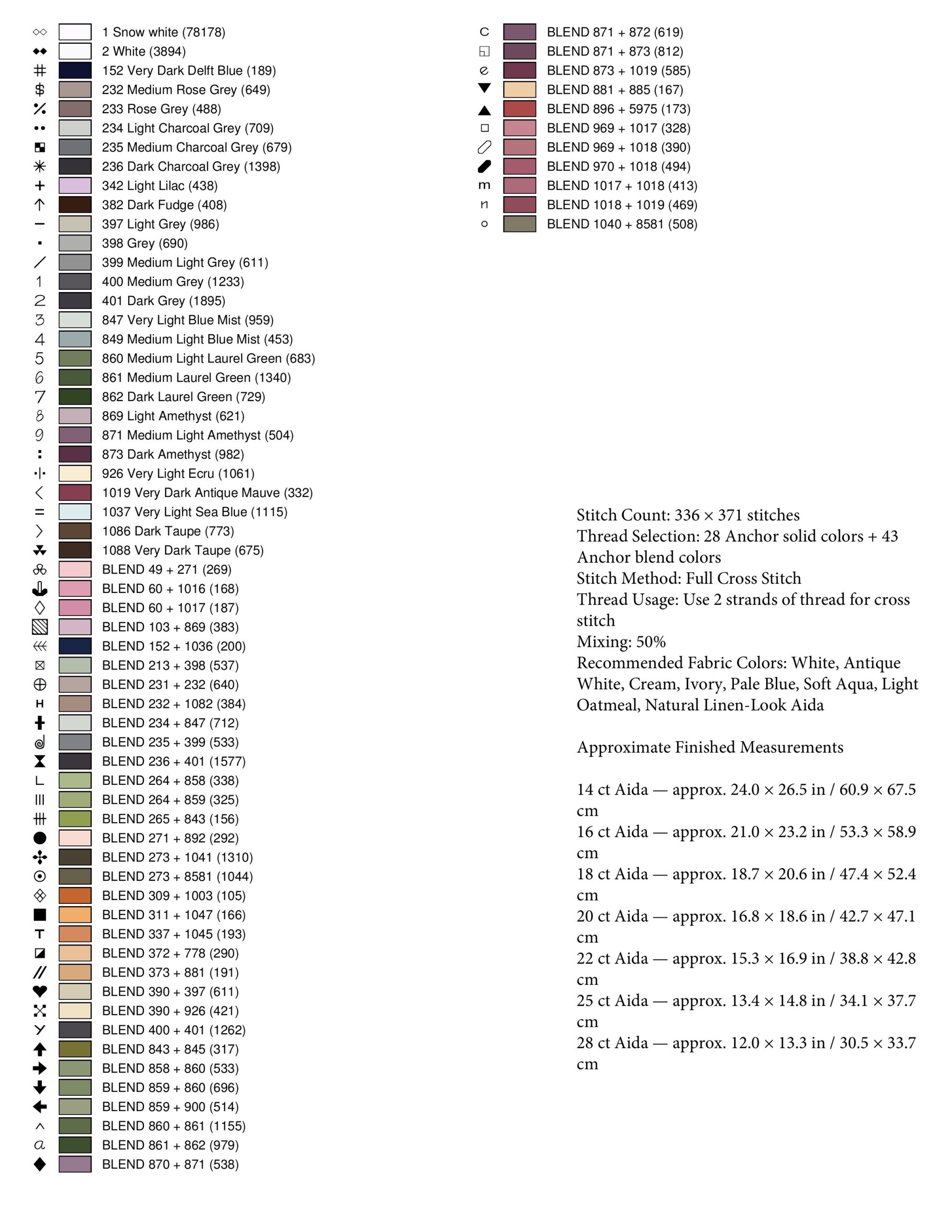
- Colors: 71 total — 28 Anchor solid colors + 43 Anchor blended colors
- Estimated Time: roughly 180–280+ hours, depending on skill level and stitching pace
Pattern Preview
Materials & Supplies
- Aida fabric, 14-count recommended (18–28 count also charted — see the size table in the FAQ). Suggested fabric colors: White, Antique White, Cream, Ivory, Pale Blue, Soft Aqua, Light Oatmeal, or Natural Linen-Look Aida.
- Anchor stranded cotton thread — this pattern is charted for Anchor brand threads, not DMC. You’ll need 71 colors in total: 28 solid Anchor shades plus 43 blended combinations (two colors stitched together — see the blending note below).
- Cross stitch needle, size 24 or 26
- Embroidery hoop or frame large enough for a project this size (a scroll frame is worth considering)
- Small bobbins or floss cards to keep 71 colors organized
- Both the full-color chart and the black & white symbol chart are included in the free download below — the color chart is easiest to follow at a glance, while the black & white version is handy for photocopying or marking up by hand.
Tips for This Pattern
- This is a full-coverage design with 71 colors, so take time up front to organize your threads — bobbins or a floss organizer will save you hours of hunting later.
- Sort your solid colors and your blended colors into separate groups before you start, and pre-pair the two strands for each blend into little bundles so you’re not re-sorting mid-stitch.
- Work in blocks (10×10 or 20×20 squares) rather than color-by-color across the whole piece — it keeps a project this large from feeling endless.
- Because the background is stitched rather than left open, keep your tension consistent throughout so the fabric doesn’t pucker over such a large area.
- Given the size, consider splitting the chart into quarters (printed or digital) so you’re always working from a manageable page.
- Good, even lighting (or a stitching lamp) makes a real difference when working with this many closely related shades.
Color & Symbol Guide
Get the Free Pattern
Color Chart
The full-color version of the pattern, easiest to follow at a glance.
Get PDF ColorPattern for FreeBlack & White Chart
The symbol-only version — great for photocopying and marking as you go.
Get PDF Black & White Pattern for FreeFAQ
What does “BLEND” mean in the color key?
A blend uses one strand each of two different Anchor colors combined together in the needle, rather than two strands of a single color. This creates a subtle heathered or shaded effect that a solid color can’t achieve. This pattern uses 43 different blends, so it’s worth pre-pairing your strands into bundles before you begin.
Can I use DMC thread instead of Anchor?
This pattern is charted specifically for Anchor brand threads, including the 43 blended combinations. You can substitute DMC using a DMC-to-Anchor conversion chart, but because so many colors in this design are custom blends, some shades may not convert perfectly — stitching with Anchor will give you the truest match to the pattern as designed.
What fabric count should I use, and how big will it be?
The pattern is 336 × 371 stitches, and 14-count Aida is recommended for the best balance of detail and stitching speed. Here’s how the finished size changes with fabric count:
| Aida Count | Finished Size |
|---|---|
| 14 ct | 24.0 × 26.5 in / 60.9 × 67.5 cm |
| 16 ct | 21.0 × 23.2 in / 53.3 × 58.9 cm |
| 18 ct | 18.7 × 20.6 in / 47.4 × 52.4 cm |
| 20 ct | 16.8 × 18.6 in / 42.7 × 47.1 cm |
| 22 ct | 15.3 × 16.9 in / 38.8 × 42.8 cm |
| 25 ct | 13.4 × 14.8 in / 34.1 × 37.7 cm |
| 28 ct | 12.0 × 13.3 in / 30.5 × 33.7 cm |
How long will this pattern take to stitch?
This is an Advanced, large-scale project — with 124,656 total stitches, full coverage, and 43 blended colors to manage, expect somewhere in the range of 180–280+ hours depending on your speed and experience. Treat it as a long-term, relaxing project rather than a quick weekend stitch.
Do I need both the color and black & white charts?
No — either chart alone is enough to stitch the full pattern. Most stitchers prefer the color chart for quick visual reference, but the black & white symbol chart is useful if you want to print it large, mark off sections in pencil, or you simply prefer working from symbols.
Conclusion
This bumblebee and thistle design is the kind of project you settle into for the long haul — a little bit each evening, watching the wings and petals slowly take shape out of dozens of closely related shades. It’s a big commitment, but the loose, painterly style makes for a genuinely striking finished piece.
Grab both free charts above, get your threads sorted, and let us know how your stitching goes — we’d love to see the finished bee in all its fuzzy glory.
📌 Pin one of these to save the pattern!