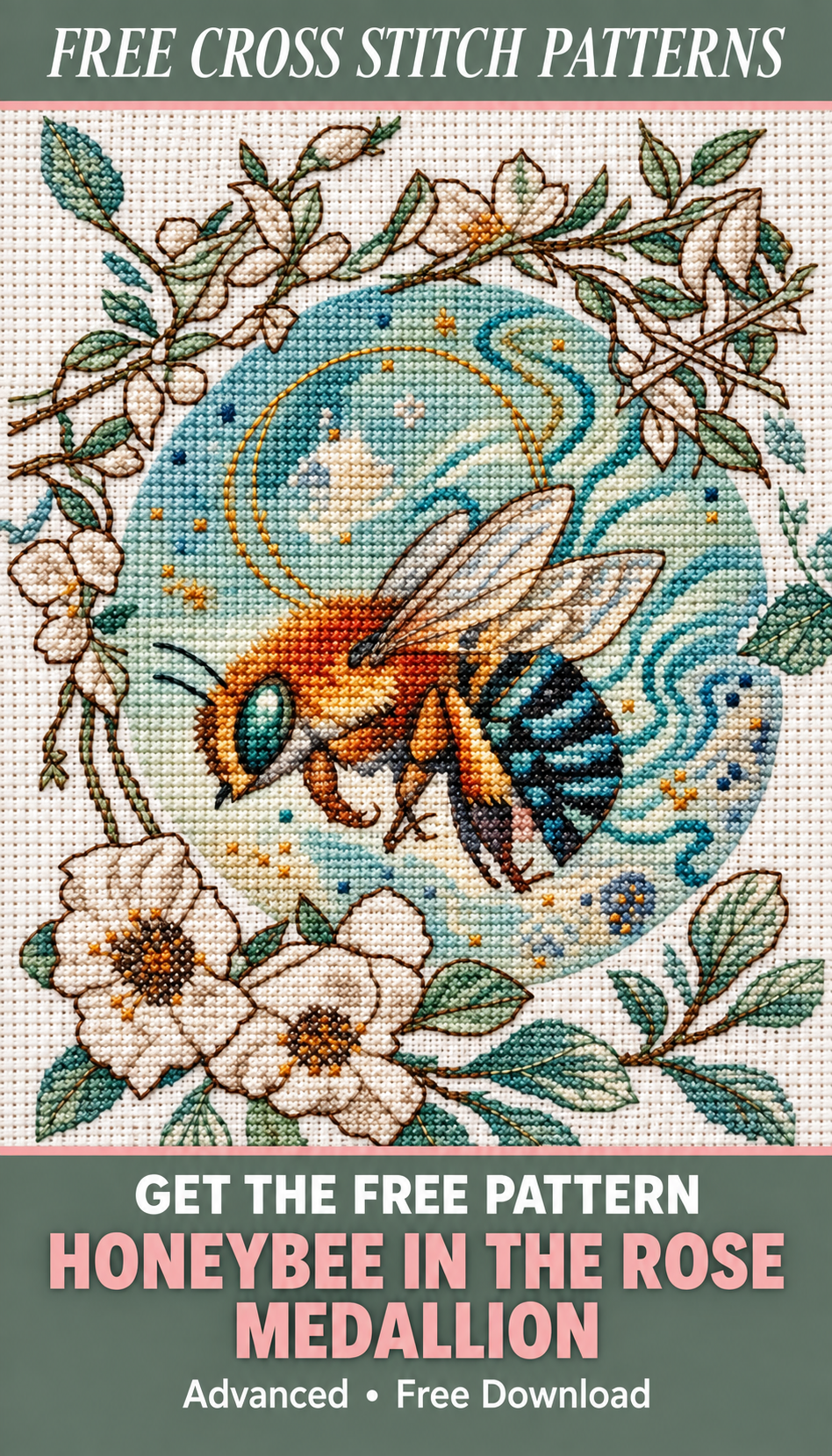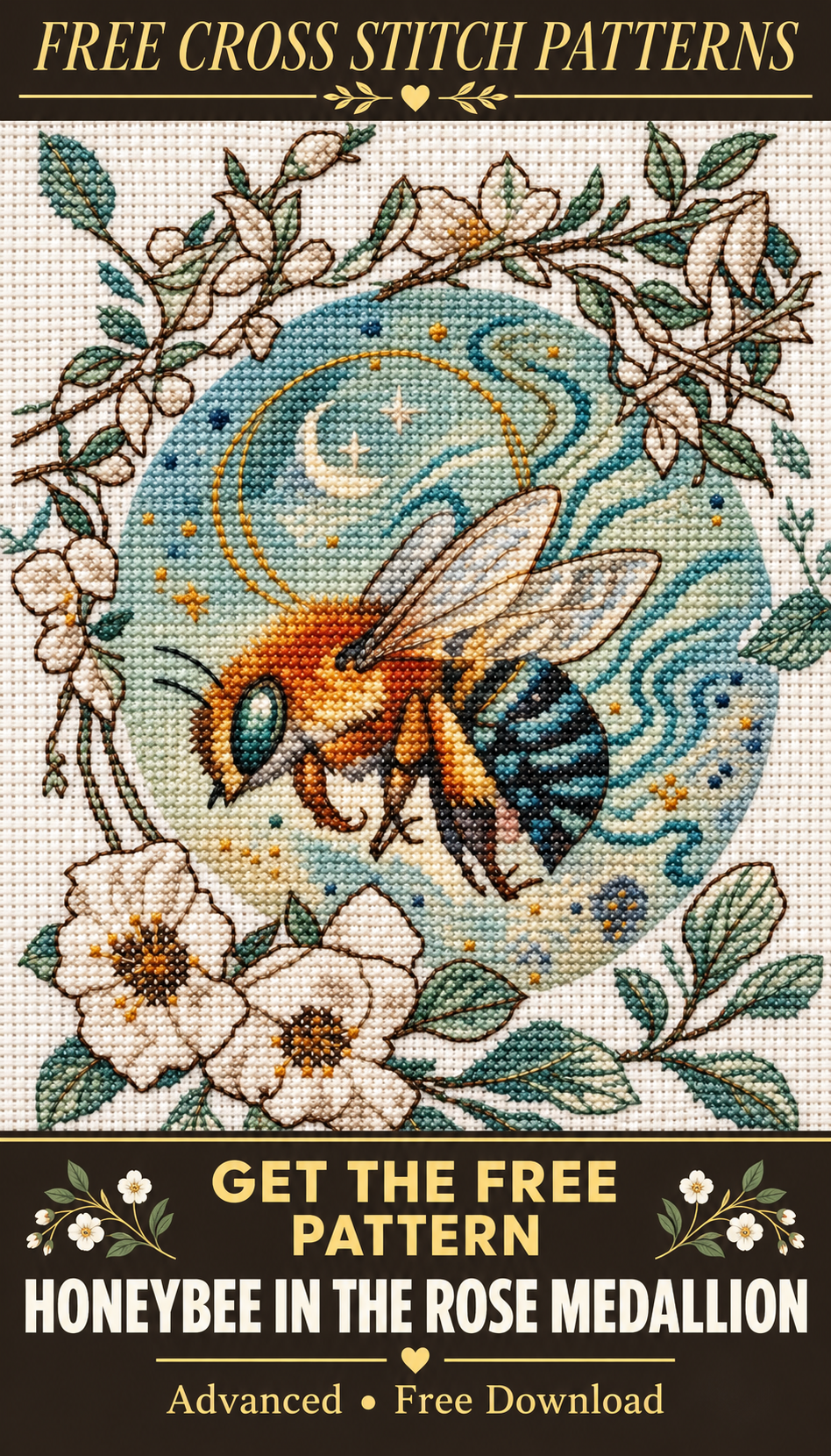
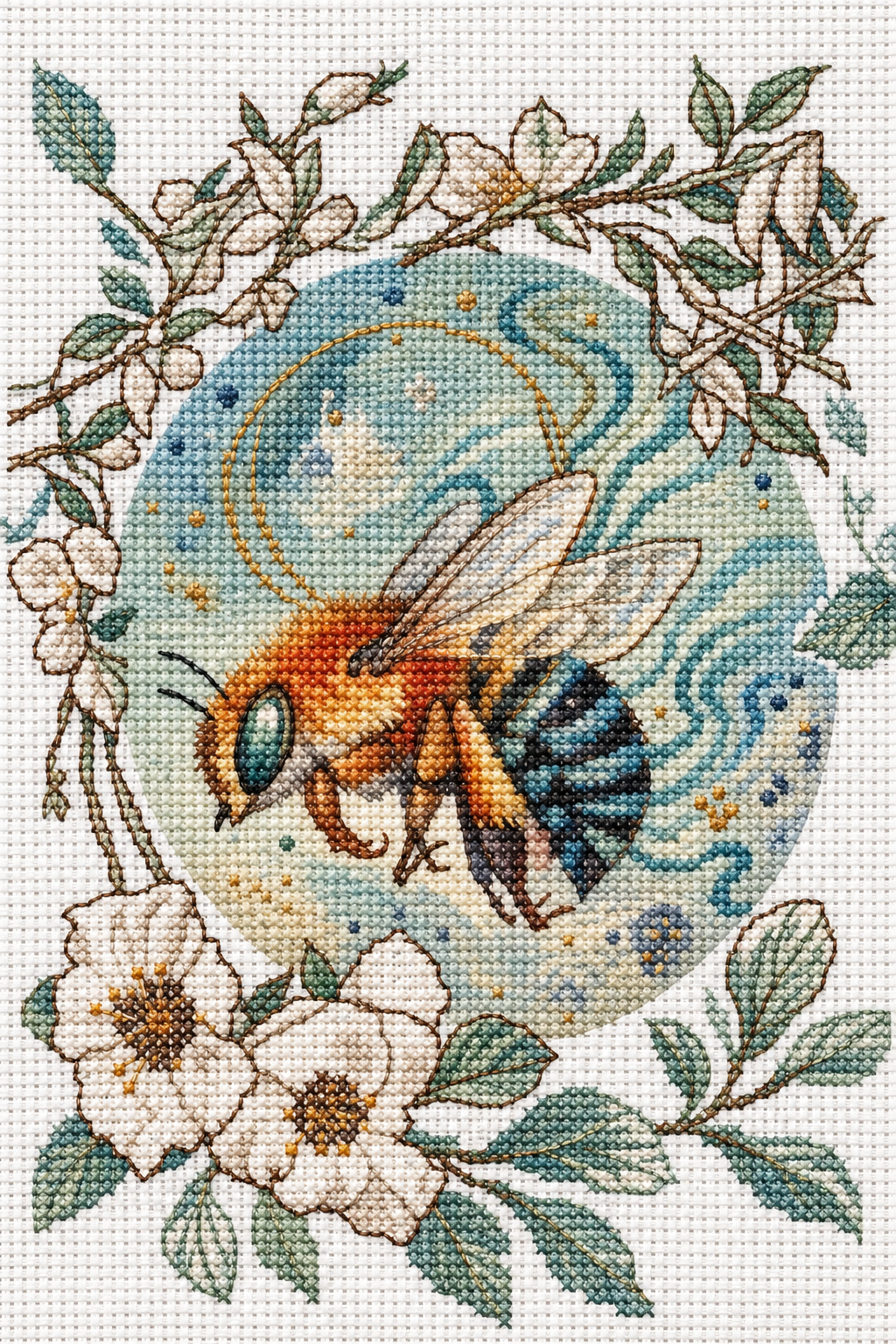
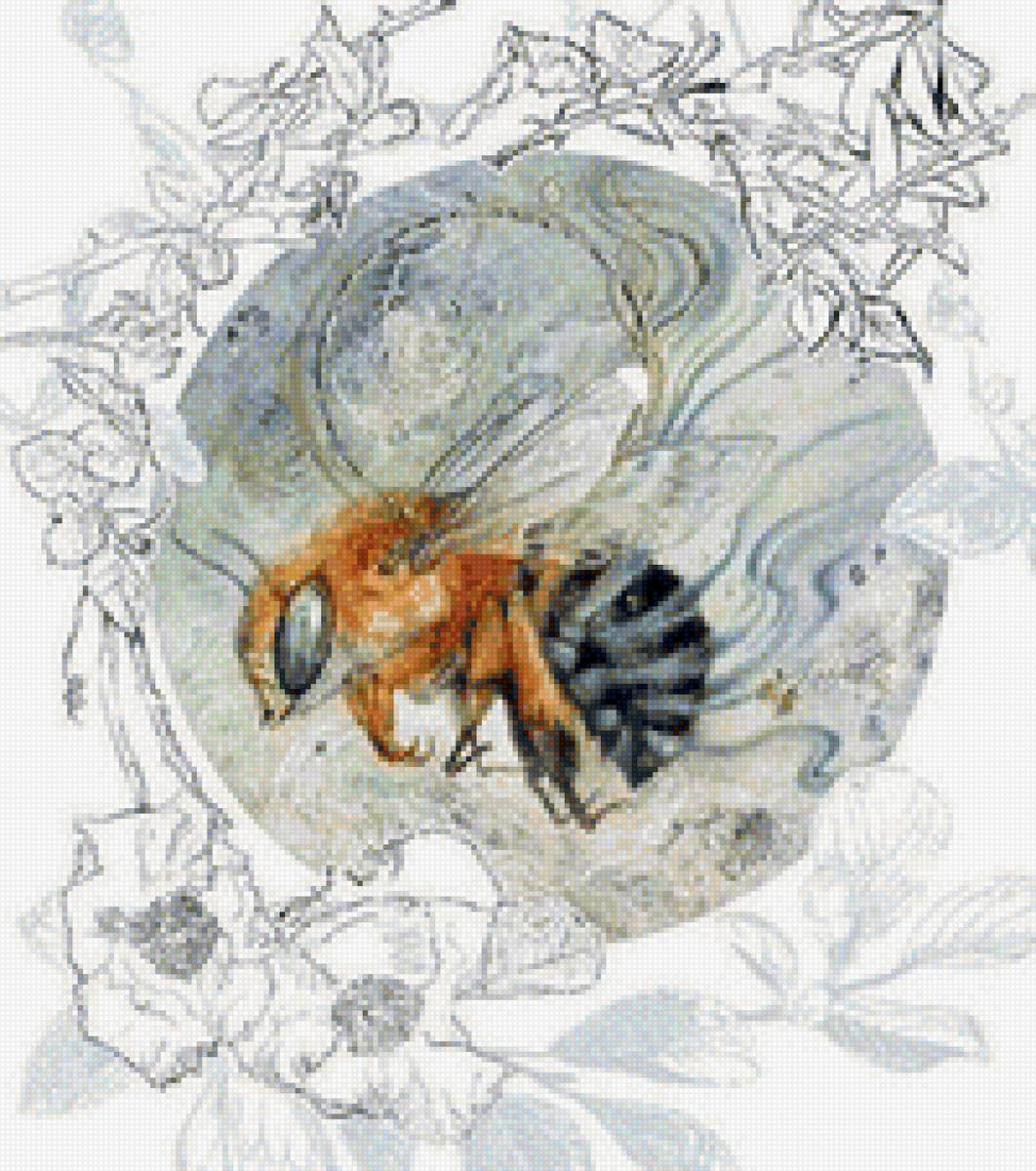
This one reads almost like a piece of vintage botanical art — a honeybee suspended inside a swirling, moonlit medallion, ringed by delicate pencil-sketch roses and trailing leaves. The muted greys and soft sandy tones inside the medallion give it a dreamy, watercolor feel, while the warm amber-and-black bee at the center anchors the whole piece.
Below you’ll find the color key, a preview of the chart, and free downloads for both the full-color pattern and the black & white symbol version. One thing to flag before you start: this chart uses Gamma brand thread numbers rather than DMC, so double-check your conversions if you’re stitching with DMC floss.
Table of Contents

Pattern At a Glance
- DifficultyAdvanced
- Fabric14-count Aida (recommended)
- Stitch Count200 × 226 stitches
- Finished Size≈14.3″ × 16.1″ on 14-count
- Colors60 Gamma brand colors
- Estimated Time40–50 hours
Pattern Preview
Here’s the finished design — full coverage stitching, with the soft grey-green medallion built from dozens of closely related neutral shades.
Materials / Supplies
Both the full-color chart and the black & white symbol chart are included in the free download. This is a full-coverage design (200 × 226 = 45,200 stitches total), worked entirely in full cross stitch using 2 strands of thread.
- 14-count Aida cloth, at least 18″ × 20″ (gives a comfortable border around the 200 × 226 stitch design)
- Gamma brand embroidery floss in all 60 colors listed in the key below — this chart is numbered for Gamma thread, not DMC, so if you’re substituting DMC floss you’ll need a conversion chart
- Recommended fabric colors: white, antique white, cream, ivory, pale blue, soft aqua, light oatmeal, or a natural linen-look Aida — any of these will work well as a base for this palette
- Size 24–26 tapestry needle
- Embroidery hoop or frame, sized to your fabric
- Small scissors and a floss organizer or bobbins — essential with 60 colors, many of them close greys and neutrals
- Good lighting or a magnifier lamp — the medallion’s background uses a lot of subtly shifting greys that are easy to mix up
Tips for This Pattern
- Sort your greys carefully. A large chunk of this palette is grey and off-white tones (several with very similar names). Label your bobbins with both the code number and a swatch of the actual floss so you’re not relying on the printed name alone.
- Start with the bee. Its warm amber and black tones are the highest contrast in the piece and give you a clear anchor point before you move into the softer, more ambiguous medallion background.
- Work the medallion in rings. Since the grey background swirls outward from the center, working it in concentric bands (rather than row by row) can help you keep track of which shade belongs where.
- Save the rose line art for last. The pencil-sketch roses around the border are fine linework — they’re easier to place accurately once the rest of the design gives you reference points to count from.
- Start from the center and work outward so the design lands centered on your fabric with even margins.
Color & Symbol Guide
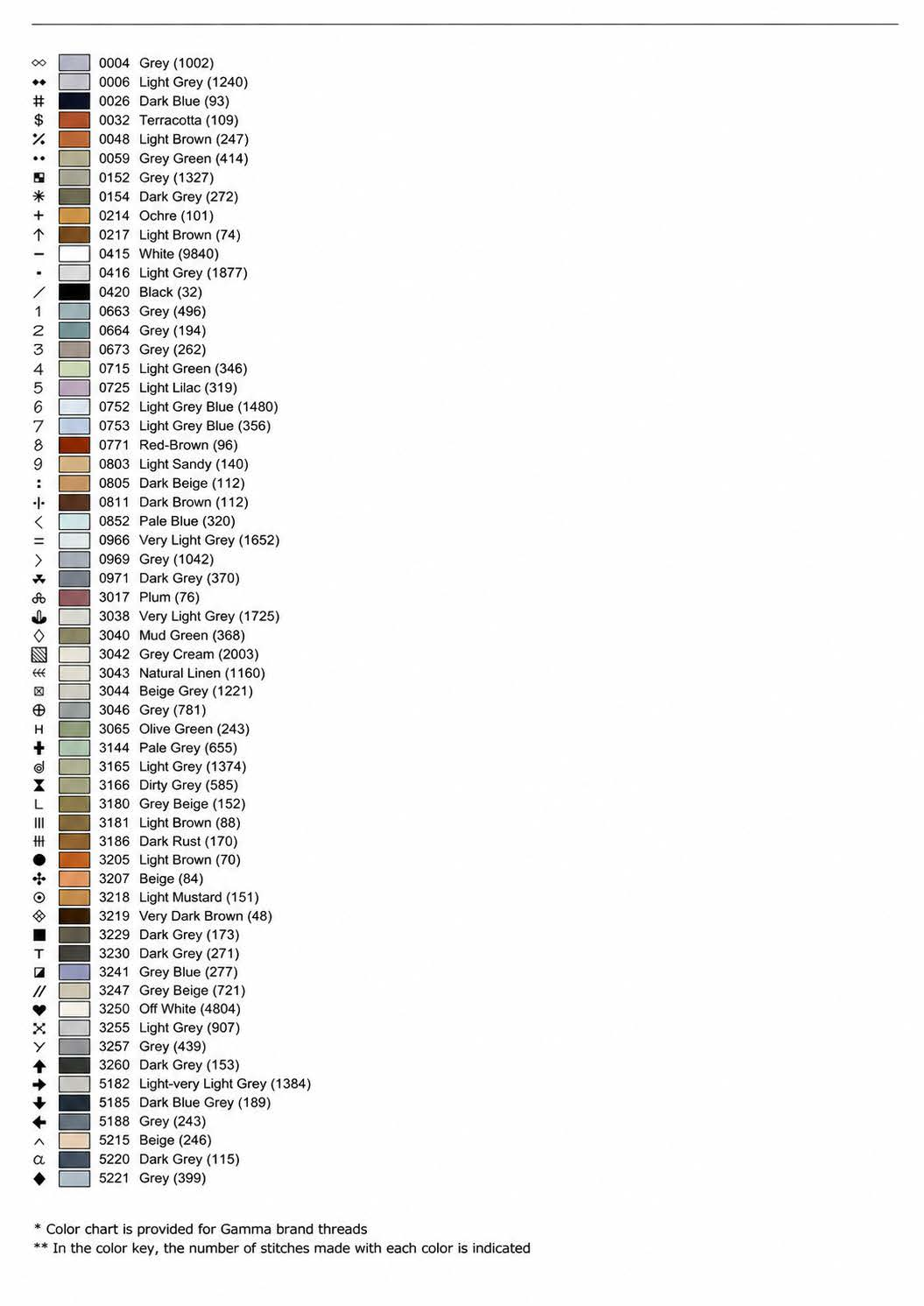
Color chart shown is for Gamma brand thread — not DMC. The number next to each color is the total stitch count for that color in the pattern.
Free Downloads
🎨 Full Color Pattern
Includes the full-color charted pages, exactly as shown in the preview above.
Watch Ad to Unlock Download⚫⚪ Black & White Pattern
Same design charted with symbols instead of color blocks — easier on ink and often easier to follow at the hoop.
Watch Ad to Unlock DownloadFAQ
What fabric size do I need, and how does it change with fabric count?
The design is 200 × 226 stitches, and the finished size scales with your fabric count:
| Fabric count | Approx. finished size |
|---|---|
| 14 ct Aida | 14.3″ × 16.1″ (36.3 × 41.1 cm) |
| 16 ct Aida | 12.5″ × 14.1″ (31.8 × 35.9 cm) |
| 18 ct Aida | 11.1″ × 12.6″ (28.2 × 31.9 cm) |
| 20 ct Aida | 10.0″ × 11.3″ (25.4 × 28.7 cm) |
| 22 ct Aida | 9.1″ × 10.3″ (23.1 × 26.2 cm) |
| 25 ct Aida | 8.0″ × 9.0″ (20.3 × 22.9 cm) |
| 28 ct Aida | 7.1″ × 8.1″ (18.1 × 20.5 cm) |
Is this DMC thread?
No — this chart’s color key is numbered for Gamma brand thread. If you stitch with DMC, you’ll want to run the Gamma numbers through a conversion chart before buying floss, since the numbering systems don’t match up directly.
How long does this pattern take to stitch?
Budget 40–50 hours. At 45,200 total stitches it’s a large full-coverage piece, and the many closely related grey tones in the medallion background mean a bit more careful color-checking than a high-contrast design of the same size.
Is this pattern good for beginners?
It’s rated Advanced, mainly for its size and the number of similar-looking neutral shades rather than stitch difficulty — it’s worked entirely in full cross stitch with 2 strands. A patient beginner could take it on, but it’s a genuine investment of time.
What’s the difference between the color and black & white versions?
The color version shows each square filled with its actual thread color, which is especially useful here for telling the many grey and off-white shades apart at a glance. The black & white version uses symbols instead, referenced against the same key — better for printing at home and easier to see clearly at the hoop.
Conclusion
This is a quietly striking piece — most of the drama comes from that soft, swirling medallion rather than bold color contrast, which makes it a lovely change of pace if you’ve been stitching brighter designs. Take your time with the greys, and the warm little bee at the center will make every hour of sorting worth it.
Grab your free copy above, and if you make one, we’d love to see it. Happy stitching!
📌 Pin one of these to save the pattern!