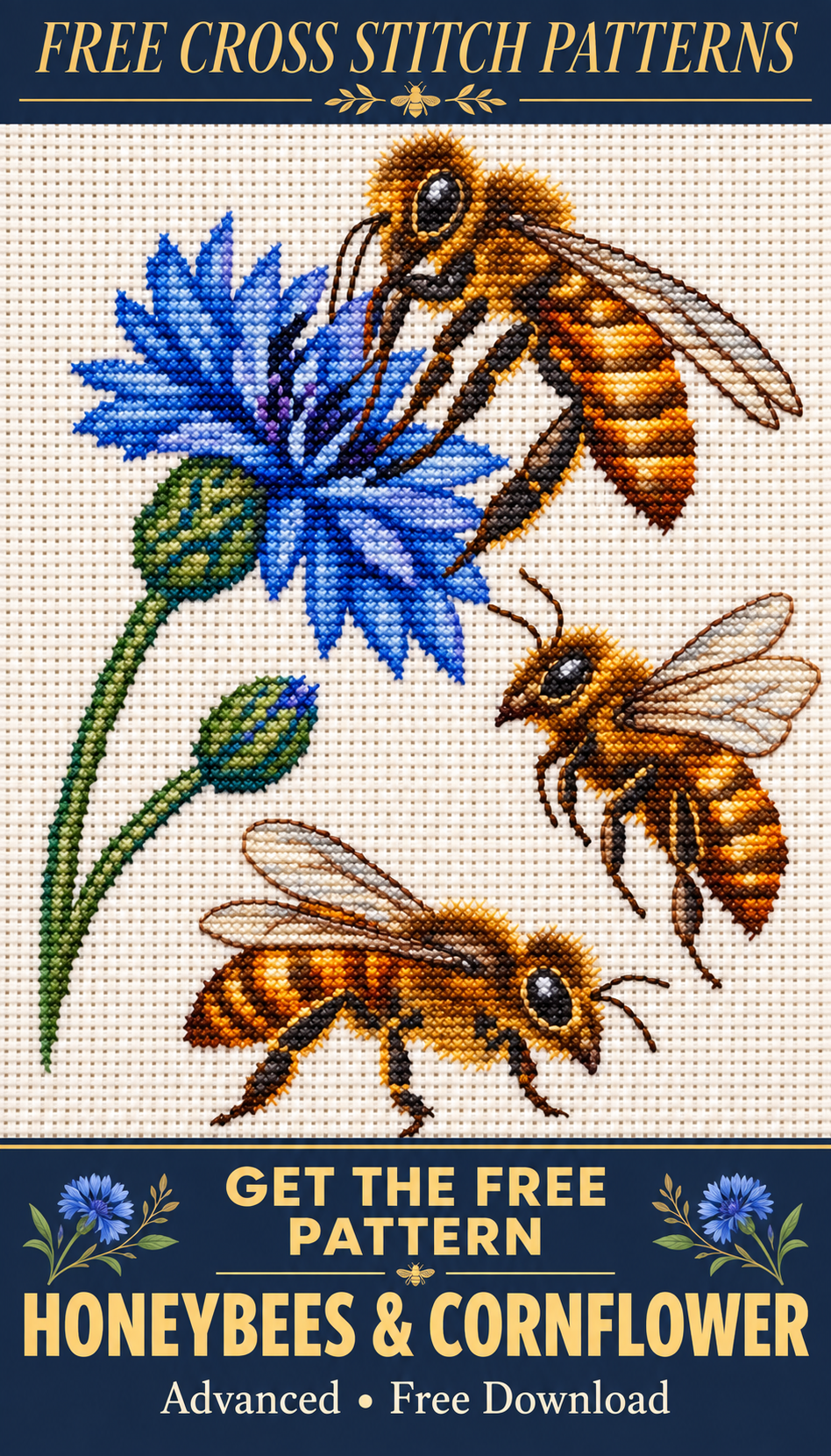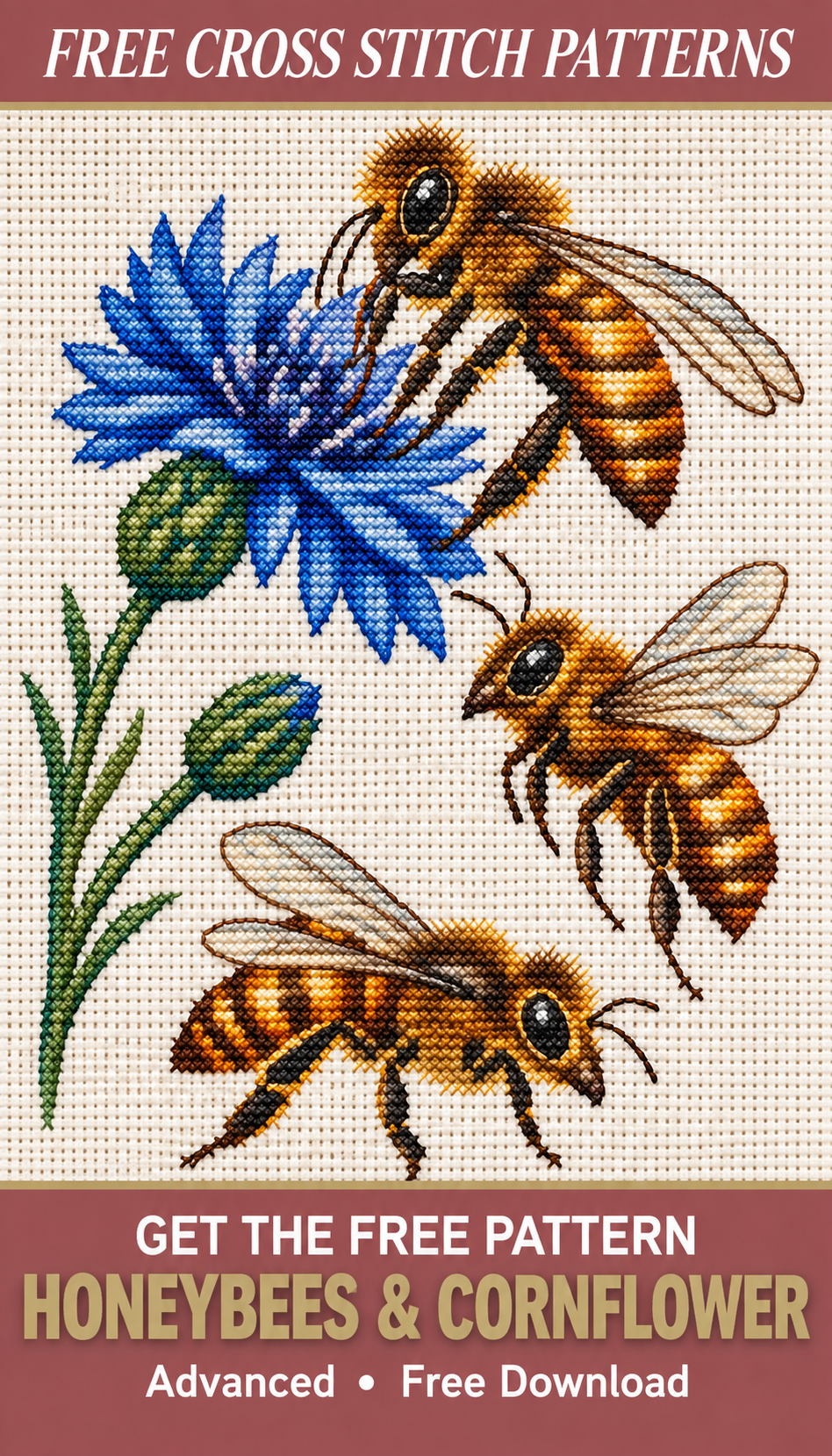
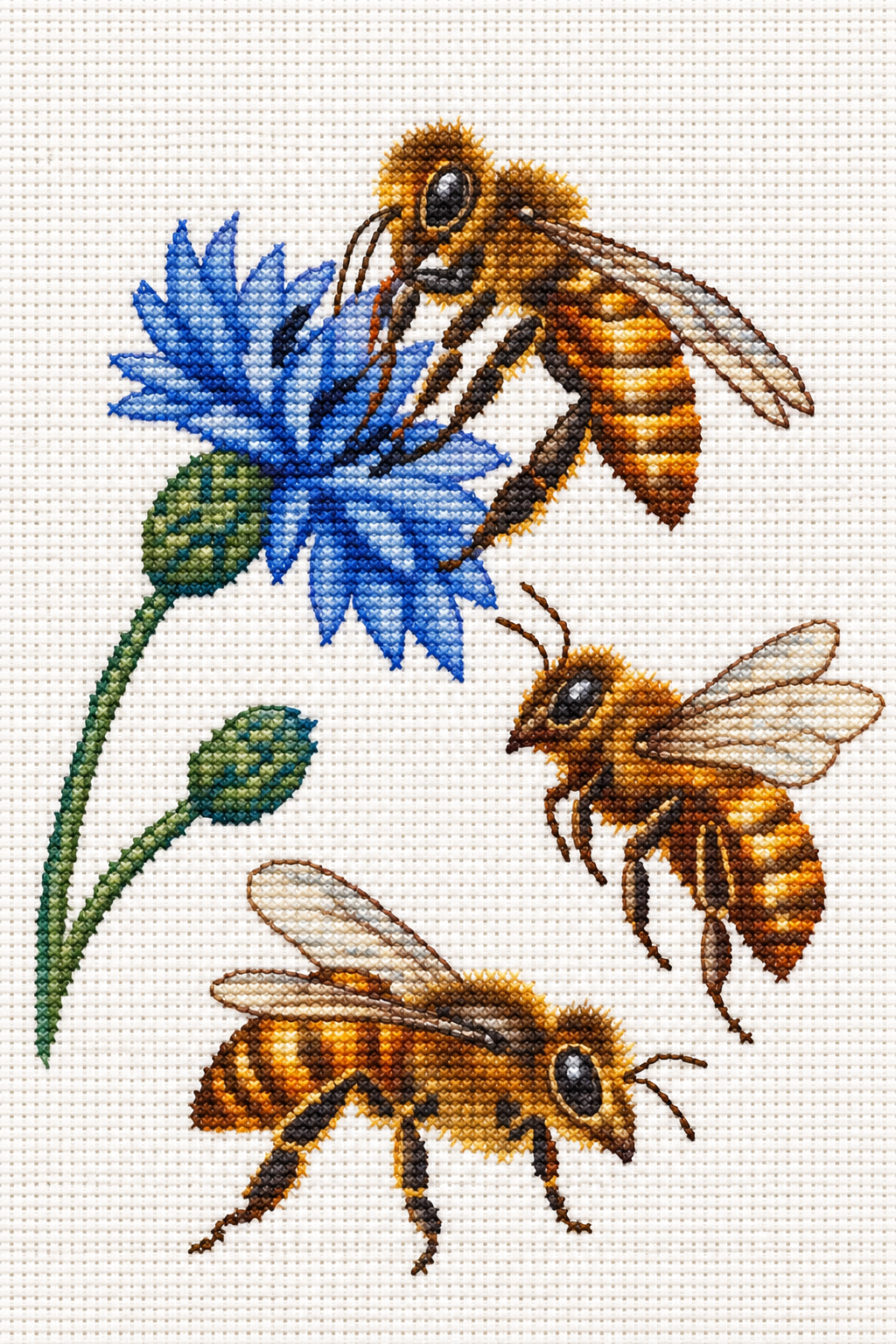
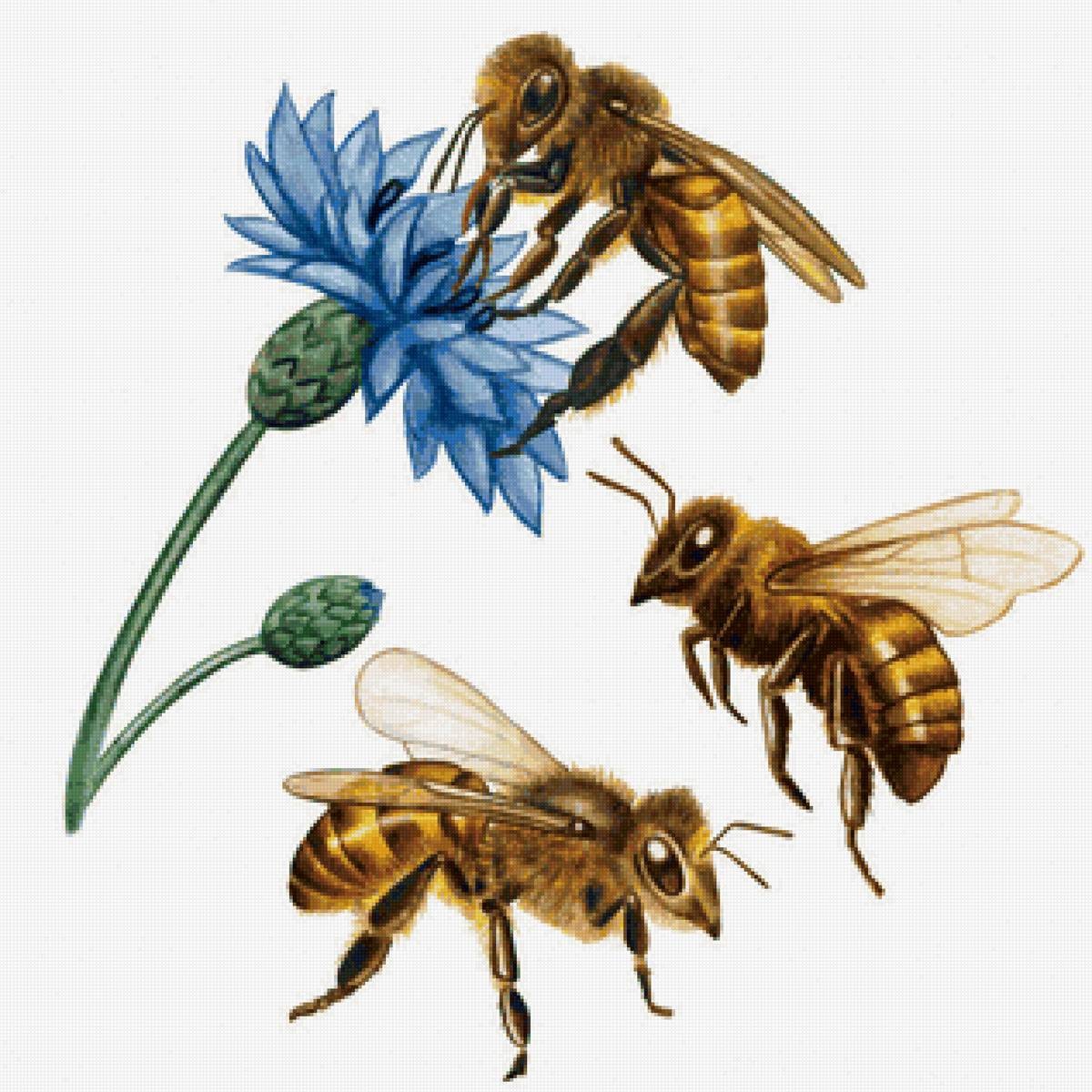
Three honeybees go about their work around a single blue cornflower in this detailed, naturalistic design — one caught mid-hover, wings a soft blur, while the other two rest and groom on the flower’s stem. It’s a botanical-illustration style piece, with fine shading in every wing vein and leg joint, paired with the clean cobalt blue of the cornflower petals.
It’s a big, full-coverage square design worked entirely in solid Gamma threads — no blending here, just careful shading built from 60 closely related colors. Both a full-color chart and a black & white symbol-only chart are included free below.
In this article

Pattern At a Glance
- Difficulty: Advanced (Large Project)
- Fabric: 14-count Aida recommended (works on 14–28 count)
- Stitch Count: 317 × 317 stitches
- Finished Size: approx. 22.6 × 22.6 in / 57.6 × 57.6 cm on 14-count Aida
- Colors: 60 Gamma solid colors (no blending required)
- Estimated Time: roughly 130–200+ hours, depending on skill level and stitching pace
Pattern Preview
Materials & Supplies
- Aida fabric, 14-count recommended (18–28 count also charted — see the size table in the FAQ). Suggested fabric colors: White, Antique White, Cream, Ivory, Pale Blue, Soft Aqua, Light Oatmeal, or Natural Linen-Look Aida.
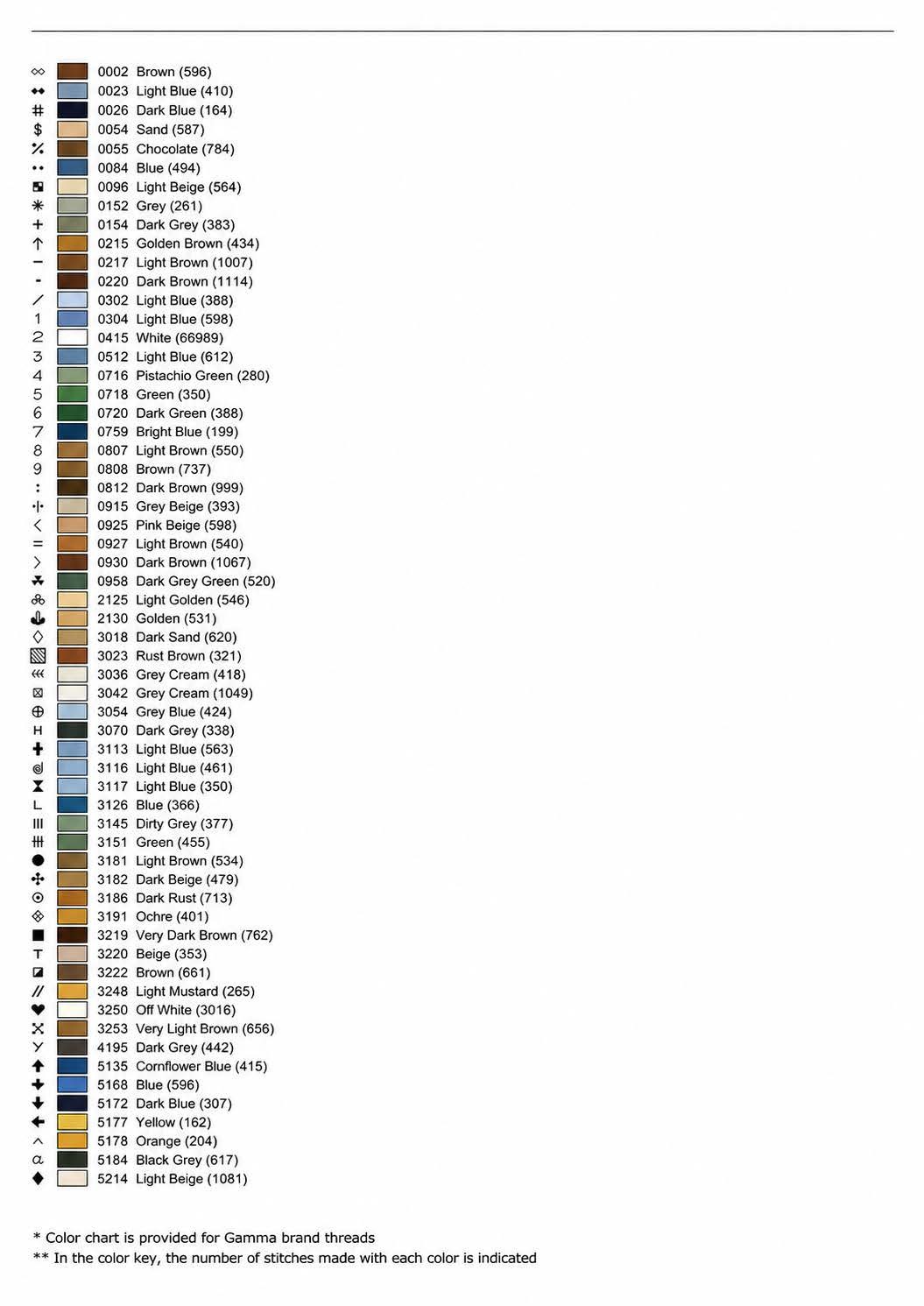
- Gamma stranded cotton thread — this pattern is charted for Gamma brand threads, not DMC or Anchor. You’ll need all 60 solid colors listed in the key below; there’s no strand-blending in this design, so each color is a straightforward single shade.
- Cross stitch needle, size 24 or 26
- Embroidery hoop or frame large enough for a project this size (a scroll frame is worth considering)
- Small bobbins or floss cards to keep 60 colors organized
- Both the full-color chart and the black & white symbol chart are included in the free download below — the color chart is easiest to follow at a glance, while the black & white version is handy for photocopying or marking up by hand.
Tips for This Pattern
- This is a full-coverage design with 60 colors, so take time up front to organize your threads — bobbins or a floss organizer will save you hours of hunting later.
- Group your golds, browns, and beiges together before you start — the bee bodies use a lot of closely related warm shades, and they’re easy to mix up at a glance.
- Work in blocks (10×10 or 20×20 squares) rather than color-by-color across the whole piece — it keeps a project this large from feeling endless.
- Because the background is stitched rather than left open, keep your tension consistent throughout so the fabric doesn’t pucker over such a large area.
- Given the size, consider splitting the chart into quarters (printed or digital) so you’re always working from a manageable page.
- Good, even lighting (or a stitching lamp) makes a real difference when working with this many closely related shades.
Color & Symbol Guide
Get the Free Pattern
Color Chart
The full-color version of the pattern, easiest to follow at a glance.
Get PDF ColorPattern for FreeBlack & White Chart
The symbol-only version — great for photocopying and marking as you go.
Get PDF Black & White Pattern for FreeFAQ
Can I use DMC or Anchor thread instead of Gamma?
This pattern is charted specifically for Gamma brand threads. You can substitute DMC or Anchor using a conversion chart, but since Gamma numbering doesn’t map one-to-one with either brand, double-check a few key shades (especially the blues in the cornflower) against your conversion chart before you start, so the color transitions still read smoothly.
Is this a full coverage pattern?
Yes — the background is stitched solid rather than left as open fabric, which is part of why the color and stitch counts run high. Full coverage designs take noticeably longer than open-background patterns of a similar size, so budget your time accordingly.
What fabric count should I use, and how big will it be?
The pattern is 317 × 317 stitches (a perfect square), and 14-count Aida is recommended for the best balance of detail and stitching speed. Here’s how the finished size changes with fabric count:
| Aida Count | Finished Size |
|---|---|
| 14 ct | 22.6 × 22.6 in / 57.6 × 57.6 cm |
| 16 ct | 19.8 × 19.8 in / 50.3 × 50.3 cm |
| 18 ct | 17.6 × 17.6 in / 44.7 × 44.7 cm |
| 20 ct | 15.9 × 15.9 in / 40.3 × 40.3 cm |
| 22 ct | 14.4 × 14.4 in / 36.6 × 36.6 cm |
| 25 ct | 12.7 × 12.7 in / 32.2 × 32.2 cm |
| 28 ct | 11.3 × 11.3 in / 28.8 × 28.8 cm |
How long will this pattern take to stitch?
This is an Advanced, large-scale project — with 100,489 total stitches, full coverage, and 60 colors to manage, expect somewhere in the range of 130–200+ hours depending on your speed and experience. There’s no thread-blending to slow you down, but the sheer size and color count still make this a long-term project.
Do I need both the color and black & white charts?
No — either chart alone is enough to stitch the full pattern. Most stitchers prefer the color chart for quick visual reference, but the black & white symbol chart is useful if you want to print it large, mark off sections in pencil, or you simply prefer working from symbols.
Conclusion
This honeybees and cornflower design rewards patience — dozens of warm golden shades slowly building into three very lifelike bees, all anchored by that one cool pop of cornflower blue. It’s a long project, but a satisfying one to watch take shape square by square.
Grab both free charts above, get your 60 colors sorted, and let us know how your stitching goes — we’d love to see the finished piece.
📌 Pin one of these to save the pattern!